

Odisha dances in two registers. Odissi came out of the temple and grew into one of India's classical dances; the folk forms, from the martial Chhau of Mayurbhanj to the sung theatre of Pala, came out of village squares and festival nights.
- Classical dance
- Odissi
- Basic stances
- Tribhangi and chauka
- Chhau styles
- Mayurbhanj, Seraikela, Purulia
- Odissi's poem
- Jayadeva's Gita Govinda
At a glance
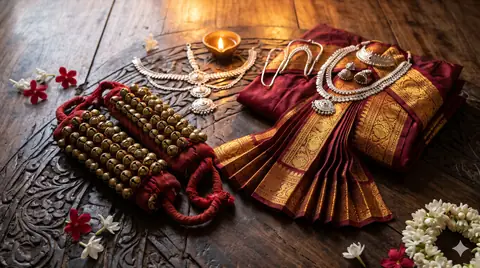 ClassicalOdissi danceTribhangi, mudras and the Gita Govinda
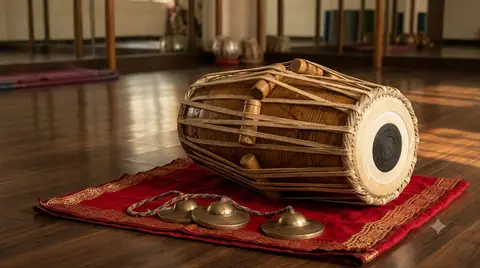 ClassicalOdissi musicIts own ragas, and the mardala drum
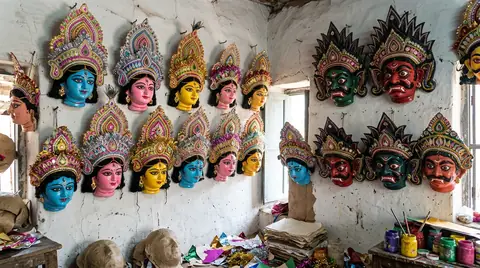 MartialChhauThree styles; Mayurbhanj's without masks
Odissi dance
Odissi is one of India's classical dances. Its roots are in the temple dancers, the maharis, who danced before Jagannath, and in the Gotipua boys who danced outside the temple. Sculptures of dancers on Odisha's temple walls show many of its poses.
- Tribhangi: the body bent in three places, at the neck, the waist and the knee, a soft, curving pose seen on temple carvings.
- Chauka: a square, grounded stance with the knees turned out, linked with Jagannath.
- Mudras: hand gestures that stand for words, objects and feelings.
- Abhinaya: the expressive part of the dance, when the dancer tells a story through face, eyes and hands.
Much Odissi abhinaya is set to the Gita Govinda, the Sanskrit poem by Jayadeva on Radha and Krishna, which is sung in the Jagannath temple. A recital usually moves from an invocation through pure dance to abhinaya and ends with a fast closing piece, the moksha.
Odissi music

The music that goes with the dance has its own ragas, rhythms and songs, many by Odia poets, sung to the mardala, the barrel drum of Odissi, with the flute, violin and cymbals.
Mayurbhanj Chhau

Chhau is a dance of eastern India with three styles: Mayurbhanj in Odisha, Seraikela in Jharkhand and Purulia in West Bengal. It draws on martial practice, with leaps, spins and mock combat, and tells stories from the epics and from nature.
In Seraikela and Purulia the dancers wear masks. In Mayurbhanj they do not: the face stays bare, and the story is told with the body. It is performed above all around the Chaitra Parba festival in spring.
Gotipua
In Gotipua, young boys dress as girls and dance in praise of Jagannath and Krishna, with songs and acrobatic poses: arches, balances and human pyramids. The village of Raghurajpur near Puri is known for its Gotipua troupes.
Pala and Daskathia
- Pala: sung storytelling by a lead singer, the gayaka, with a chorus and drums. It mixes song, poetry, wit and stories, and grew up around the worship of Satya Pir, honoured by Hindus and Muslims alike.
- Daskathia: two performers, one telling and singing a ballad and the other answering him, keeping time with the kathi, a pair of wooden clappers. It is strongest in southern Odisha.
Dalkhai and the folk dances
Dalkhai is a folk dance of western Odisha, danced by young women in a line to Sambalpuri songs and drums. Every region has its own folk dances, and in the Koraput hills it is the dhemsa, a line dance with arms linked, danced at festivals and weddings.


